

Why Generic Service Content Never Gets Cited by AI
When someone asks ChatGPT or a Google AI Overview about a home repair problem, the AI has to choose what to cite from what’s written on a page, not what a business hopes it conveys. Most service pages give it nothing usable: the same few sentences about quality and experience that every competitor’s page also has.
We recently rebuilt a real client’s entire service page structure using search data, customer reviews, and years of video history instead of guesswork. The gap between generic content and content an AI can extract facts from turned out to be the whole story.
AI search engines can only cite what is specific and verifiable. Generic service copy gives them nothing to extract. We rebuilt a real client’s service pages using search data, 216 real customer reviews, and years of its video history, and found specific, evidence-backed content actually gets cited.
The Real Problem: Thin, Generic Content
Ask most home service websites what causes a cracked foundation, and you’ll get the same paragraph. Settling soil. Poor drainage. Tree roots. It reads fine. It also reads exactly like every competitor’s page, because it was written the same way theirs was: by someone who knows the general category but not the specific answer to what a real customer is asking.
Real customers don’t ask generic questions. They ask what’s causing the exact crack above their window, what it will cost to fix a bowing basement wall, and what their actual options are besides tearing the whole thing out. A page that only covers the general category has nothing to say to any of that.
Some of this thin content comes from AI tools now, a business owner asking a chatbot to “write a paragraph about foundation repair” and publishing whatever comes back. But that’s one cause among several, not the whole explanation. Plenty of this content predates AI entirely: copied from a competitor’s site, pulled from an agency’s reused template, or written from whatever the business owner remembers customers asking about five years ago. The common thread isn’t where the words came from. It’s that none of it answers anything specific enough for a real customer, or an AI reading on that customer’s behalf, to act on.
This isn’t just a hunch. Kevin Indig’s Growth Memo analysis found content structured as a direct answer to a specific question gets cited roughly twice as often as content that isn’t. Separate research out of Ahrefs found pages built around unique data points and specific quotes get a measurably higher citation rate than pages that repeat general industry knowledge. Generic content is structurally invisible to the systems now deciding which businesses get recommended.
The Test Case: A Service List Built on Guesswork
A longtime, family-run foundation and masonry repair company in the Atlanta metro came to us with a site rebuild already underway. An internal team member had taken the company’s original list of 19 services and cut it down to 12, on his own judgment, with no research behind the decision. Some of the cuts were reasonable. Some weren’t. Nobody could say which was which, because nobody had checked.
This is the default failure mode, not an unusual one. A business lists its services the way the business itself talks about the work, or the way one person on the team happened to think about it that week. Whether that list matches what customers search for, need answered, or call about constantly is rarely checked at all.
Real Demand Data Instead of Guessed Jargon
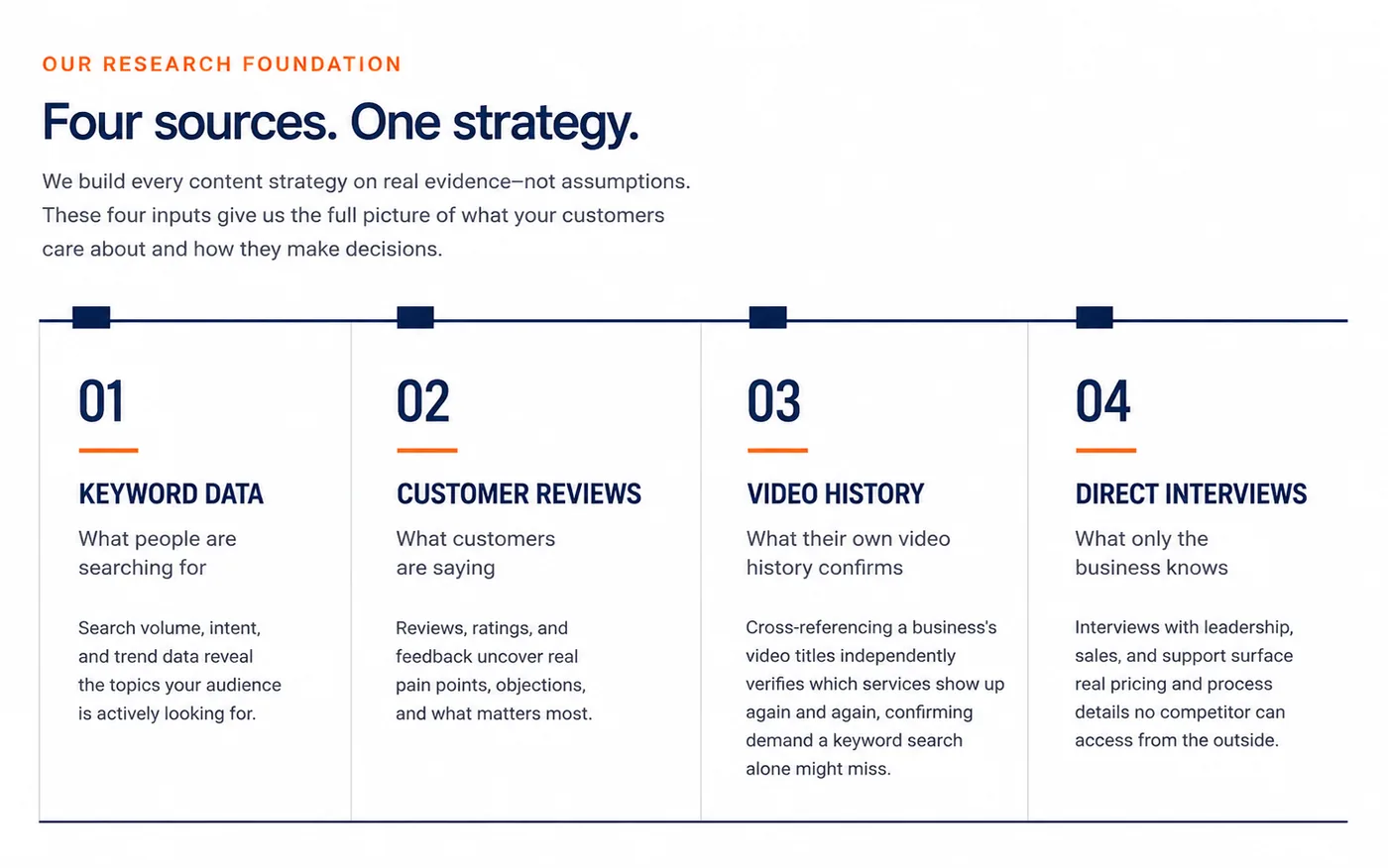
We ran real keyword research against every one of the 19 original services, not just the 12 that survived the internal cut. Some of what we found confirmed real, strong demand: “foundation repair” pulls 60,500 searches a month nationally, and “foundation repair contractors” pulls another 27,100. Other services turned out to be pure internal jargon with no search footprint at all. “Helical piers” and “pre-construction piers” returned almost nothing, just generic DIY concrete calculators mixed in.
One case mattered more than the rest. The client had a service for structural cracking above a garage door, caused by a sagging support beam. Internally, everyone called it by its technical name. But “garage door repair” pulls 246,000 searches a month, for openers and springs, a completely different business. Anything titled around that phrase would pull the wrong customers by sheer volume, even if the underlying repair work was real and common.
Zero Search Volume Doesn’t Mean Zero Demand
Two services on the list tested at effectively zero search volume, no matter how the symptom was phrased. One covered sinking front steps and stoops pulling away from the house. The other covered settling deck posts. Neither term, nor any variation of it, showed up as something people search for.
That result alone would normally be a reason to cut both. Instead, we went back to the client’s Google reviews and found 13 separate customers, spanning years, independently describing the exact same steps-and-stoop repair, unprompted, in almost identical language: a stoop pulling away from the foundation, a gap forming, a builder who never tied the steps to the foundation in the first place. Deck post settling showed the same pattern across five more reviews.
Zero search volume doesn’t mean zero demand. It can mean the number is too small for a keyword tool to report on its own, or that the real term gets swallowed by something bigger and unrelated, the same way the garage repair case did. Reviews and video history don’t have that blind spot, because they’re not measuring what people type into Google. They’re recording what happened.
A Third Layer of Verification
Before finalizing anything, we pulled the client’s own YouTube channel and cross-referenced every video title against the same service list. The pattern held. Steps and stoop repairs showed up in dozens of titles. The garage-beam repair showed up in dozens more, going back years, confirmed as recent as a few months before this project.

One thing surfaced that hadn’t been on the list at all: outdoor fireplace repair. It showed up in customer reviews and in the video history, independently, more than once. Three separate sources agreeing on something nobody had planned for is a real pattern worth acting on, not a coincidence to explain away.
What Your Google Reviews Already Told You
Most businesses treat their reviews as a trust badge, a star rating and a scrolling carousel, and stop there. We read all 216 of this client’s reviews in full and sorted them by which specific service each one described.
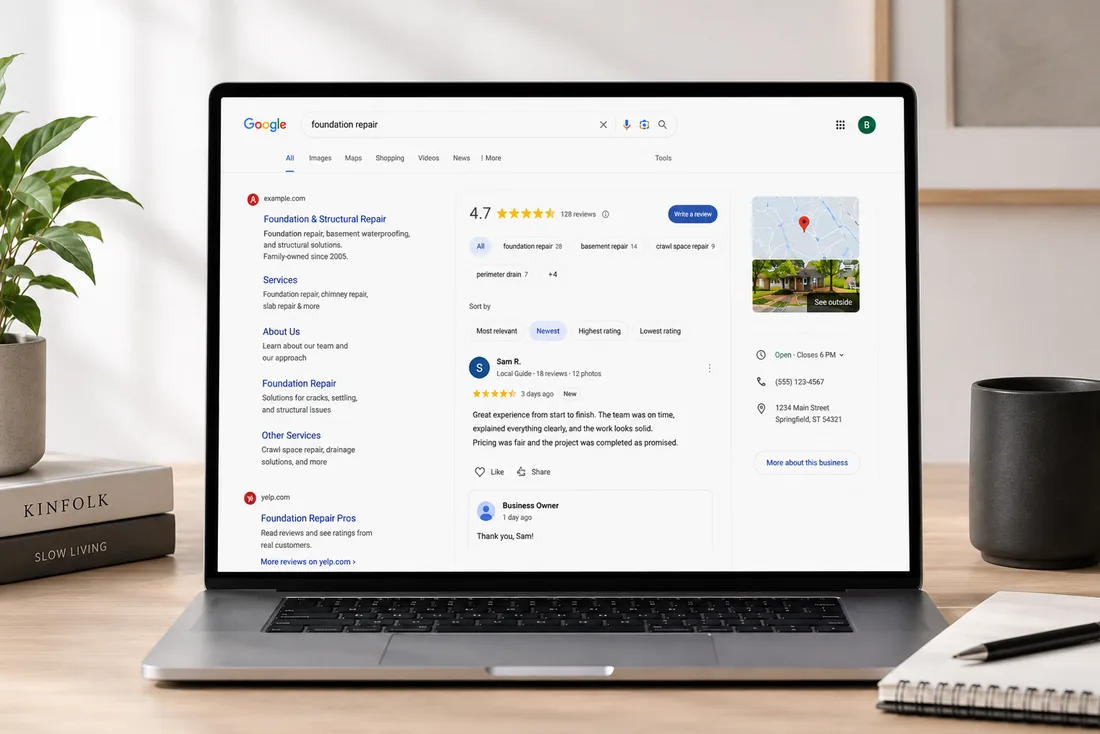
The result wasn’t a generic list of compliments. It was structured, attributable evidence. Eighty-six reviews described foundation work specifically. Forty-nine described brick wall repair. Thirty-two used the word “recommend,” seventy-three used “professional,” twenty-six used “honest.” One customer, comparing four different companies before choosing this one, wrote that the first three “couldn’t guarantee a price, couldn’t guarantee they could get the job done, or flat out” failed to follow through. Another, describing a sagging beam above a garage, used the exact internal repair term the company itself used, proof that real customers do learn and use specific language once someone takes the time to explain the actual problem to them.
None of that had to be invented, guessed, or generated. It was sitting in public reviews the business had never gone back and read as a body of evidence.
The Layer Competitors Can’t Copy
Reviews and video history are public. A competitor could, in theory, run the same research we did. What they can’t copy is what only exists inside the business itself: real pricing, the actual step-by-step process explained in the business’s own words, specific technical detail, and whatever comes up naturally in real sales and customer conversations.
There’s more than one way to get at that. Recorded sales and customer-service calls can be mined directly for real language and real objections. Structured interviews with different parts of an organization, leadership, marketing, inside sales, customer support, business development, each recorded and transcribed, surface different truths: sales knows the pricing objections, support knows the recurring complaints, leadership knows the real differentiation story nobody’s written down. Surveys and direct voice-of-customer interviews round it out.
For this project, direct interviews came first. We built a real discovery framework: the exact price range for each service, the real step-by-step repair process in the client’s own words, two or three recent job examples per service with real outcomes, and what happens if a customer ignores the problem for another year. That’s the material a competitor reading the public site will never have, because it doesn’t exist anywhere public to copy.
The Payoff: Specific, Real, and Answerable, Not Generic
The finished result was 12 service pages, the same page count the client started with, but built from evidence instead of guesswork. Two services almost cut for having no measurable search volume stayed, because real customer and video evidence proved they were common, valuable work. One service got renamed entirely to avoid pulling in customers looking for a completely different repair. A missing service, confirmed by three independent sources, got added back.
Every page carries specific answers instead of general ones: real price ranges instead of “contact us for a quote,” real customer language describing the actual symptom instead of an industry term nobody searches, and a “why choose us” section built entirely from counted, attributed review evidence instead of invented claims.
This isn’t hypothetical upside. Local search analyst Darren Shaw has documented AI systems citing a business’s own testimonials page directly, reasoning through an answer with lines like: “I chose that business because it has 700 reviews and a 4.9 rating according to themselves, according to the testimonials page they have on their website.” A page built from real, counted, specific review evidence is exactly the kind of source material an AI system can quote back to someone deciding who to call.
That’s what an AI answer engine can use. A generic paragraph about foundation repair gives it nothing to extract. A specific answer, backed by a real number and a real customer’s own words, is exactly the kind of fact an AI system can pull into a cited answer. It’s the same research discipline that used to just mean writing a better page, done now with tools that make real depth possible at scale.
Frequently Asked Questions
Isn’t this just more work than writing generic copy?
Yes, and that’s the point. Generic copy is fast to write and easy for a competitor to match, because it isn’t based on anything specific to the business. The research described here takes real time, but it produces something a competitor genuinely cannot reproduce without doing the same work themselves.
What if a business doesn’t have hundreds of reviews yet?
Fewer reviews just means the review-mining layer carries less weight relative to the others. Keyword research and direct interviews with the business still surface real, specific content either way. A newer business leans harder on direct interviews and department-level knowledge extraction, since that layer doesn’t depend on review volume at all.
Doesn’t AI already do this kind of research automatically?
No. An AI tool can run keyword research or summarize a batch of reviews if it’s pointed at real data and asked the right questions, but it can’t interview a business’s sales team, pull real pricing out of a leadership conversation, or notice that a service showing zero search volume actually has real demand hiding behind a crowded, unrelated keyword. That judgment call, and the willingness to go find a second and third source before accepting what one tool says, is still a human decision.
Isn’t jargon just another way of saying “the wrong keyword”?
Not quite. A wrong keyword is a targeting mistake. Jargon is a deeper problem: it means the business is describing its own service in words a customer wouldn’t recognize as the description of their problem at all. Fixing it takes more than swapping one search term for another. It takes finding out what a customer actually calls the thing they’re experiencing.
Key Takeaways
- Generic service descriptions give AI search engines nothing specific to cite, and give real customers nothing specific to act on.
- Real keyword research separates genuine demand from internal jargon a business uses but no customer ever searches.
- Zero search volume doesn’t always mean zero demand. It can mean the real term is too small to measure or buried under something bigger and unrelated.
- Public reviews and video history are often the fastest, cheapest way to confirm real demand a keyword tool alone would miss.
- The details a competitor can never copy, real pricing, real process, real internal conversations, only come from directly working with the business itself.
Ready to see what your own site’s content gives an AI to cite?
Book a free 15-minute service-page audit. We’ll pull real search data for your current service list and show you exactly which pages are specific enough to get cited, and which ones are giving AI search nothing to work with. Get in touch and we’ll show you exactly where you stand.